
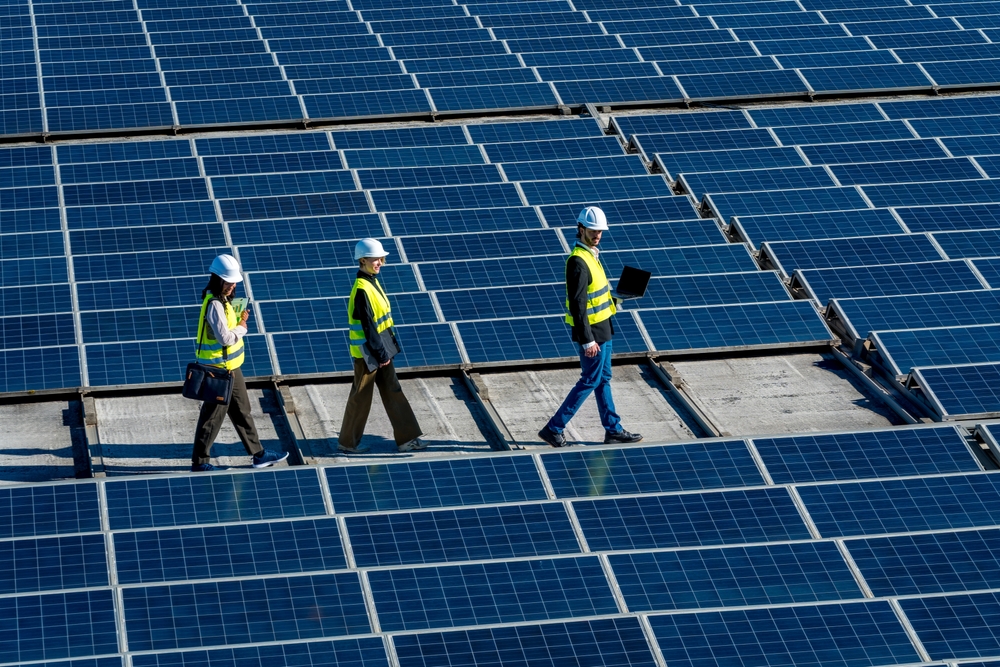
The certification organization presents a hands-on O&M workshop for the people responsible for system uptime.
Building solar and storage is only the beginning. Keeping those assets safe, productive, and bankable for decades depends on trained technicians following proven standards. Yet when budgets are tight and faults demand attention, routine maintenance is often the first thing to slip.
That’s where the North American Board of Certified Energy Practitioners (NABCEP) comes in. As an association partner of Intersolar & Energy Storage North America (IESNA), NABCEP works to raise professional standards for the solar workforce through education and credentialing. Its new PV O&M Associate Technician (OMAT) credential, for example, establishes baseline competency in safety protocols, maintenance procedures, and operational standards for residential through utility-scale PV assets.
At the upcoming 2027 IESNA Flagship event, NABCEP is putting that work into practice with Hot Topics in Electrotech Operations and Maintenance (O&M), a three-hour workshop, led by NABCEP’s training partner, Solar Tech Collective.
Below, Brian Mehalic and Rebekah Hren of Solar Tech Collective share what’s behind the topic and what workshop attendees can expect.
“Why Does Preventative Maintenance So Often Get Deprioritized?”
Operators are balancing uptime against cost, and in that tradeoff, reactive maintenance often crowds out preventative work. Over time, system performance suffers.
“Preventative O&M gets pushed down the priority list primarily because its return on investment is notoriously difficult to quantify compared to the immediate, visible need of repairing an offline or faulted component,” said Rebekah.
But a benefit that’s hard to measure isn’t a small one. Issues that go unchecked tend to become faults, and a fault means lost production plus an emergency repair that could have been planned. Preventative work is how operators avoid paying for both.
A second challenge is people. Hiring, assessing, and training technicians to do the work safely is its own bottleneck, and a maintenance plan is only as strong as the crews carrying it out. “We develop training both to meet industry needs and to support qualifying for NABCEP credentials. And we deliver it to individuals, EPCs, utilities, O&M providers, and manufacturers,” Rebekah explained.
What Effective O&M Looks Like
Solar Tech Collective and NABCEP say the workshop’s three topics were chosen to provide a picture of effective O&M, from high-level planning to hands-on field execution of the most useful and common tasks. Each one also protects revenue:
- Planning: A documented program built on NFPA 70B and manufacturer guidelines gives owners and managers a concrete structure to take to the people who control the spend, and helps protect the asset’s long-term value.
- Prevention: Annual infrared thermography, called for by NFPA 70B on all electrical equipment, spots failing connections and components before they force an emergency call, turning unplanned work into planned work. It also has some uses unique to PV systems.
- Response: A detailed procedure for troubleshooting PV ground faults gets crews to the problem faster and restores the system safely, putting it back to generating revenue sooner.
For O&M providers and installers, a consistent, safety-focused process is also a business advantage: it makes reliable service and repeat work more likely.
“What’s Changing in the Field?”
NFPA 70B, the Standard for Electrical Equipment Maintenance, became a formal standard in 2023, and NABCEP sees it as a tool the industry should know and rely on more. It isn’t typically enforced the way the National Electrical Code is, but it gives owners and operators a clear structure for an electrical maintenance program.
What it doesn’t do is show companies how to put that structure into practice. “It unfortunately doesn’t provide a precise roadmap for how companies can actually get there—a gap this workshop aims to fill,” said Brian.
The equipment is changing, too. Inverter-based systems, both transformer-based and transformerless, are growing more complex, and fielded systems continue to age. That makes safe, standardized troubleshooting with digital multimeters and insulation resistance testers more important than ever.
And through it all, safety comes first. For companies building a safety culture, NABCEP points to NFPA 70E, which covers safety in the electrical workplace.
Who Should Attend?
This workshop is designed for anyone involved in the maintenance of electrical equipment, specifically focusing on commercial and large-scale PV and battery energy storage systems.
System owners, O&M providers and program managers, and field technicians will leave with practical ways to structure more efficient and impactful projects and improve their practical troubleshooting skills.
Additionally, manufacturers will gain the programmatic and field perspective on what it takes to safely and effectively maintain their products and the systems they belong to.
Join NABCEP and Solar Tech Collective at IESNA Flagship
The next fault should be a planned fix, not a fire drill.
You’ll leave this workshop with a framework for structuring your maintenance program, a thermography routine you can put to work on your next inspection, and a field-tested ground-fault procedure for your crews—in addition to 3 hours of NABCEP continuing education units.
Details:
- Date: February 9
- Time: 1:15 – 4:15 PM
- Location: IESNA Flagship, San Diego Convention Center in San Diego, CA
- Price: $380
- Register here
Interested in learning more about NABCEP? Visit Booth #2350 to connect with the team onsite at the event.