

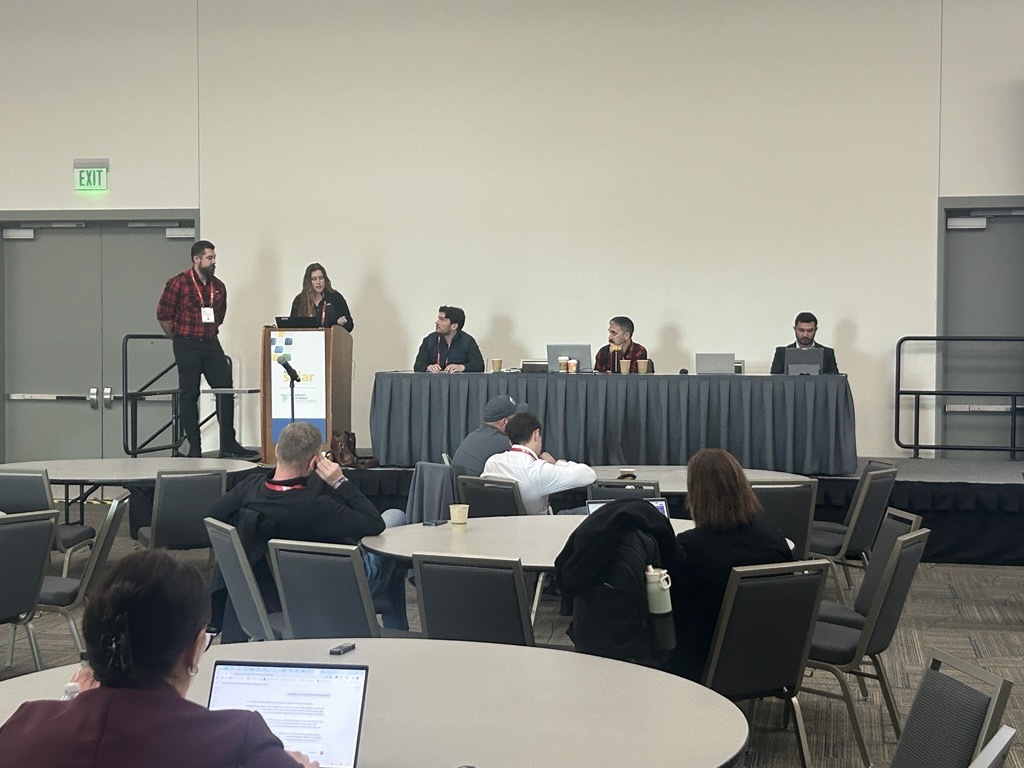
With federal subsidies on hold and market pressures intensifying, solar and storage developers gathered for a pre-conference summit during the Intersolar & Energy Storage North America (IESNA) Flagship event that couldn’t have been more timely. The three-hour afternoon session promised insider strategies for reducing construction costs early in the development process – and delivered exactly that.
The interactive summit brought together five industry veterans representing different pieces of the solar development puzzle: Chris Squitieri, senior director of power and renewables business development at Encompass Energy Services; Zack Overfield, south central cultural resources lead at HDR; Masih Qutb, senior director of civil engineering at Apex Clean Energy; Bonnie Doggett, environmental project manager at HDR; and John Wayne Rejebian, head of engineering and partner at Blended Power.
Their collective message was clear: cost efficiency now demands a strategic, phased approach where early investment in due diligence prevents catastrophic expenses during construction. As the summit description emphasized, with subsidies on hold, developers must sharpen their focus on maximizing project value without compromising quality.
“Every day that you can’t work is costing you a quarter million dollars in equipment rental,” Rejebian said early in the session, setting the tone for a deep dive into strategies that separate successful projects from financial disasters. The format encouraged peer-to-peer discussion, with participants bringing their own project challenges to work through collaboratively.
The Risk-Based Approach: Spend Small Early, More Later
The workshop opened with a fundamental framework that challenges conventional cost-cutting instincts. Chris Squitieri presented a development pipeline visualization showing how project value increases in stages – but with a catch.
“At each stage, if studies show this is a bad project, all your money and time is gone. It’s a sunk cost,” Squitieri explained. “That’s why it makes sense to use cheaper tests early in the process instead of waiting until you’ve got a million dollars into it.”
The panel emphasized a stair-step approach where desktop studies come first, followed by progressively more detailed field investigations as project value increases. The key is matching the level of investigation to the stage of development.
For geotechnical work, Qutb described their phased methodology: “We don’t jump right into geotech. We do a desktop study first to evaluate what we’re dealing with – historical projects around the site, what sort of site it is. Then as the project gets bigger and goes through later stages, that’s when we start actual fieldwork.”
An Arizona case study illustrated this perfectly. Two adjacent sites showed dramatically different subsurface conditions that desktop data had predicted: one site had a 1% pile refusal rate while the site across the road hit 20% refusals. “Desktop data can tell you it’s bad, it can tell you it’s good,” Rejebian noted. “Soil doesn’t swirl. It doesn’t change its behavior rapidly underground.”
The Hidden Cost of Cheap Studies
A recurring theme was the false economy of minimal early spending. Multiple panelists cautioned that developers who skimp on initial studies often pay twice.
“A lot of EPCs will not take your site to construction if your field studies expose them to millions of dollars of liability,” Squitieri said. “The amount of times I get a call that says, ‘Hey Chris, I know you did the survey and topo, redo it.’ I’m like, why? Because we’re about to bring in three million dollars of dirt onto the site. If it’s off by 1%, that’s 300,000. We’d rather give you 50K to survey the site again.”
The panel recommended working with EPCs earlier in the process to share study scopes and avoid duplication. “We try to get with the EPC earlier on and work with them to narrow down the geotech scope so we don’t have to spend the same amount of money twice,” Qutb explained. “Instead of having to pay for it twice, whether the EPC does it or we do it, we try to just minimize that spend.”
Schedule: The Ultimate Cost Driver
Perhaps the workshop’s most striking insight came from Rejebian’s comparison of two identical 150-megawatt projects. The first phase had a nine-month construction schedule and was plagued with issues. The second phase lasted 14 months.
“The second project was the best project I’ve ever worked on – the least amount of people on site, the least amount of change orders, about a third of what we had on phase one,” Rejebian said. “I was getting concerned calls from my ownership saying, ‘We’ve only got 30 people on site today. What are they doing?’ Everyone was worried. But we were right where we needed to be. No one could comprehend what was happening because it was so atypical, but it was where we should have been all along.”
The panel identified compressed schedules as the root cause of most construction problems: inadequate labor, safety incidents, and cascading change orders. “Every injury I’ve ever had on a job as a project manager was due to a condensed schedule – too many people on site,” Rejebian noted. “The answer to being behind is to throw more bodies, but usually those bodies aren’t as skilled, and then you’ve got more congestion, and that’s how people get hurt.”
Real-Time Monitoring Prevents Liquidated Damages
Squitieri demonstrated a drone-based tracking system monitoring a 50,000-pile installation project on the Indiana-Ohio border. The system updates daily, showing exactly which piles and racks have been installed across five arrays.
“All of a sudden the EPC can ask educated questions: you said you had four installers, why don’t we see three points of progression?” Squitieri explained. “You’re not approaching day 300 when you’re almost at a completed project where liquidated damages and litigation come into play. You’re calling when there’s still time to save this.”
On that specific project, the monitoring revealed the contractor wouldn’t finish on time using their planned approach. “They literally kicked off installers from arrays D and E because they realized before construction they weren’t going to finish in time. They said, stick to arrays A, B, and C. We’re going to get another crew for D and E. This literally happened two weeks ago. That’s how you make money.”
The alternative? “One year of profitability down the drain. Additionally, your third-party insurance cost just took a 20% increase,” Squitieri warned.
The Golden Array Strategy
The panel recommended establishing a “golden array” approach – building one perfect array first to align all trades before replicating across the site.
“Do your first array, get it right, so you can look at everything: wire management, module installation, runs from the end of the road to the combiner box, inverter, grounding,” Rejebian said. “Do one array and get everybody on the same page, then replicate that across the site.”
This approach creates a physical template that prevents misunderstandings and reduces rework. Combined with regular coordination meetings, it ensures all subcontractors understand their sequencing and dependencies.
Community Engagement Can’t Be an Afterthought
Zack Overfield emphasized that stakeholder engagement is as critical as technical studies.
“The more you do upfront, the better the outcome, even if it may not seem like it,” he said. “You’re talking to angry landowners every week – it can be exhausting. But when they feel heard, it’s a lot easier to stomach. If it feels like you’re walking all over them and you’re from out of town, by the time you need something and you’re talking to them, they’re less likely to be compliant.”
Bonnie Doggett cautioned against over-promising on visual mitigation. “As much as you can get away with using existing vegetation, the better,” she said. “A lot of times when you introduce new plantings, it requires irrigation no matter how hard you don’t want to irrigate it, and irrigation adds complexity to a very simple project.”
She noted that expensive landscaping buffers often become liabilities rather than assets. “I’ve seen too many really expensive trees die when planted and not cared for, and that can cause major headaches down the road.” Her advice: work with what’s already on site and plant appropriately for the season to ensure vegetation actually thrives.
The panel discussed countering property value concerns with data and education. A Florida case study showed how a landowner’s testimony about agricultural chemical usage helped put solar panels’ minimal environmental impact in perspective.
The Coordination Catastrophe
Perhaps the workshop’s most cautionary tale involved a $300 million project in 2024 where coordination failures led to a near-bankruptcy scenario.
“Nobody contracted the trench,” Squitieri revealed. “The civil guy went to the electrical guy and said, ‘When are you going to start trenching?’ He goes, ‘That’s what I was going to ask you.’ People got fired. Reputations got trashed. But this was avoidable.”
The lesson: detailed pre-construction coordination meetings where every trade walks through their scope and timing are essential, not optional.
Civil Contractors: The Biggest Variable
The panel identified civil contractors as the highest-risk element in project execution because they vary most frequently between projects.
“We might, as a developer, use the same module installer for 16 projects in 16 states,” Rejebian noted. “A civil might change every single project. That’s just the reality. You’re building roads, fences, drainage – things that are highly site-specific.”
This variability demands extra scrutiny during contractor selection and closer oversight during construction.
The Bottom Line
The workshop’s central message was that cost efficiency in the current market requires inverting traditional cost-cutting instincts. Strategic early spending on studies, adequate schedules, real-time monitoring, and thorough coordination prevents exponentially larger costs during construction.
As Rejebian summarized with the contractor’s adage: “Proper preparation prevents poor performance. Never forget the five P’s.”
For developers navigating a subsidy-constrained environment, the path to profitability runs through meticulous planning and the discipline to invest upfront in de-risking – even when offtake agreements seem distant and every dollar counts.