
The Storage Moment Is Here — Four Voices From the IESNA Exhibit Hall Floor
By Krista Simicich, IESNA Digital Editor
Walking the floor of the Intersolar & Energy Storage North America (IESNA) Flagship event, one thing becomes immediately clear: the conversation has shifted. Solar is no longer just about panels — it’s about what happens after the sun goes down.
Between climbing utility rates, extreme weather events, and the AI-driven energy demand surge, just generating power isn’t enough anymore: you need to be able to hold onto it. That urgency was palpable on the show floor this year, and the exhibiting companies are racing to meet it.
We spoke to four of them — Yotta Energy, Sol-Ark, EcoFlow, and ABC Supply — to find out what they’re building, where they see the market heading, and why they believe the storage moment has undoubtedly arrived.
Storage Is No Longer Optional
 If there was one theme threading through every conversation we had in the exhibit hall, it was this: battery storage has moved from “nice to have” to “essential.” James Mason, Vice President of Renewable Energy at ABC Supply put it plainly: rising utility rates, fueled in part by the surging energy demands of AI, are making the case for storage almost automatically.
Attachment rates are climbing nationwide, he noted, and he sees that momentum opening up markets in regions that haven’t historically been solar-forward. “I think a lot more markets are going to open up to not only storage, but photovoltaic generation of solar energy,” he said. “It’s going to depend on where you are geographically — if you’re in a high energy cost market versus a low energy cost market — but I think there’s just going to be overall growth and excitement about renewables in general.”
Sol-Ark co-founder and Chief Business Development Officer Bhavna O’Brien echoed that view, pointing to the commercial and industrial (C&I) segment as the clearest opportunity. It’s a space Sol-Ark has been investing in for years — they introduced their 30K and 60K inverters for C&I three years ago precisely because, as O’Brien put it, “that area was neglected.”

Back then, utility-scale projects had their own storage solutions, but smaller commercial buildings were largely left without good options. Now, she sees the rest of the industry catching up to where Sol-Ark has been. “You see a lot of other companies, once again, following Sol-Ark’s lead,” she said, “making sure that we have power for small pharmacies” and similar businesses that have long been underserved.
Andrew Tanner, CTO of Yotta Energy, brings a long view to this moment. He’s spent 12 years working in distributed energy storage for C&I — long enough to remember when the promise of this market always seemed just out of reach. “It’s always had so much promise, but has never reached that tipping point,” he reflected. This year feels different. “You can just feel that the tide has turned, and we’re on that wave.” He sees the sunsetting of residential ITC incentives as a key catalyst, pushing EPCs and developers to redirect their focus toward commercial projects, and toward solutions like Yotta’s that are purpose-built for that segment.
The Innovators Raising the Bar
Two companies on the floor stood out for the distinctiveness of their product stories: one pushing the boundaries of hardware design, the other making energy resilience feel personal and urgent.
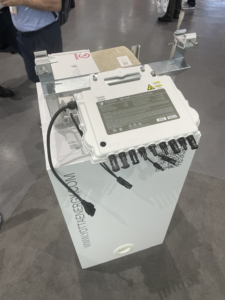
Yotta Energy is doing something genuinely unlike anyone else: mounting a modular 1 kWh battery directly beneath each rooftop solar panel. The second-generation YottaBlock, which the company showcased at IESNA Flagship, pairs with a three-phase microinverter available in both 208V and 480V versions, and stores energy direct DC-to-DC — straight from the PV module into the battery — which Tanner says makes it one of the most efficient storage solutions on the market, running at around 94% round-trip efficiency.
The core engineering challenge is thermal management. It gets hot under a solar panel, and most batteries simply aren’t designed for that environment. Yotta’s solution is a patented phase-change heat exchange system, using a high-grade wax material paired with unidirectional heat exchange technology, that passively regulates the battery temperature without any moving parts, no HVAC, and no annual service visits.
The contrast with conventional containerized storage is stark. “The dirty little secret that most containerized energy storage solution providers won’t tell you,” Tanner said, “is that they’re consuming 10 to 30 percent of their capacity during the summer months to keep themselves thermally regulated.” Yotta, by design, consumes none.
There’s also a practical installation advantage that’s easy to overlook. Because YottaBlocks sit beneath the solar modules on a roof, they displace the concrete ballast blocks that would otherwise be there. That means the marginal cost of adding storage to a rooftop installation is dramatically reduced. “The marginal cost to install our technology is near zero,” he said.
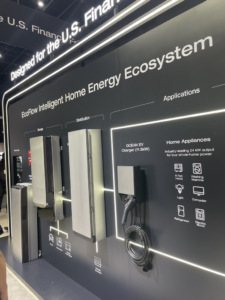
On the consumer side of the storage story, EcoFlow is making waves with OceanPro, their whole-home energy backup system that earned Time Magazine’s Best Invention of 2025. With over 600 units installed since launching last summer, the product is finding its market and the timing couldn’t be better.
Jeanette Holton, EcoFlow’s representative at the show, pointed to the drumbeat of extreme weather events reshaping how homeowners think about energy. “Houston with the floods and hurricanes, the wildfires in California, even the blackouts,” she said. “It’s very relevant nowadays.” The result is a fundamental shift in consumer mindset: “Having whole home backup is no longer just a luxury thing to have. It’s actually a necessity now, and people are starting to realize that.”
EcoFlow is also working to remove financial barriers to adoption, with U.S.-friendly financing options designed to make the system accessible to a broader range of homeowners. And with FEOC approval expected in the near term, the company is positioning OceanPro for even wider market reach.
Bringing It All Together: Education, Access & Support
Great hardware only goes so far. What struck us in several conversations was how much thought is going into the ecosystem around the products, ensuring that installers, distributors, and end users are set up to succeed.
Sol-Ark’s product roadmap for the next 12 months is substantial. There’s a new 12K inverter with 100-amp pass-through, designed to work with virtually all homes. A revenue-grade meter and meter collar are in the pipeline. A new commissioning app will make it easier for teams to manage C&I installs in the field.
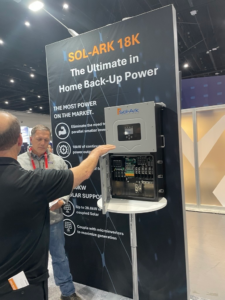
But perhaps the most forward-looking initiative is their white-glove commissioning service, a program where Sol-Ark can place one of their engineers on-site during large project commissioning. O’Brien was candid about why this matters right now: “There are a lot of residential installers now moving into the commercial space,” she said, and bridging that knowledge gap is critical.
That’s where Sol-Ark University comes in, an online portal giving installers access to training videos, electrical and fire code guidance, and system-specific installation instruction. It’s a comprehensive resource that reflects how seriously Sol-Ark takes the installer relationship — not just selling hardware, but building long-term capability in the people who deploy it.
For ABC Supply, the story is one of steady, purposeful expansion. The distributor is growing its renewables presence across the country, with a particular focus on building momentum in the northeast over the next 12 months.
Mason’s framing of ABC Supply’s role is telling. Rather than positioning the company as pivoting away from its traditional business, he describes renewables as an addition to it. “I call it addition, not necessarily a transition,” he said, “to help power America.” It’s a philosophy that reflects both the company’s scale and its long-term commitment to supporting the industry’s growth without losing sight of where it came from.
Looking Ahead
What stands out from these conversations is a sense that the solar and storage industry is approaching a genuine inflection point: not a future promise, but something that is actively unfolding.
The C&I segment is opening up in a meaningful way. Storage is becoming the default, not the exception. Domestic manufacturing and FEOC compliance are front of mind for suppliers and buyers alike. And the companies best positioned are the ones who have been quietly building toward this moment for years.
EcoFlow’s Jeanette Holton put the broader mission simply: “Our main goal as a company is to get energy accessible to everybody. Everybody should have the right to clean energy.” It’s a sentiment that resonated across the exhibit hall, from the engineers reimagining how batteries sit on a rooftop, to the distributors making sure the right products reach every corner of the country.
As Tanner summed it up: “A rising tide floats all boats.” From where we stood at this year’s flagship event, that tide is very much coming in.