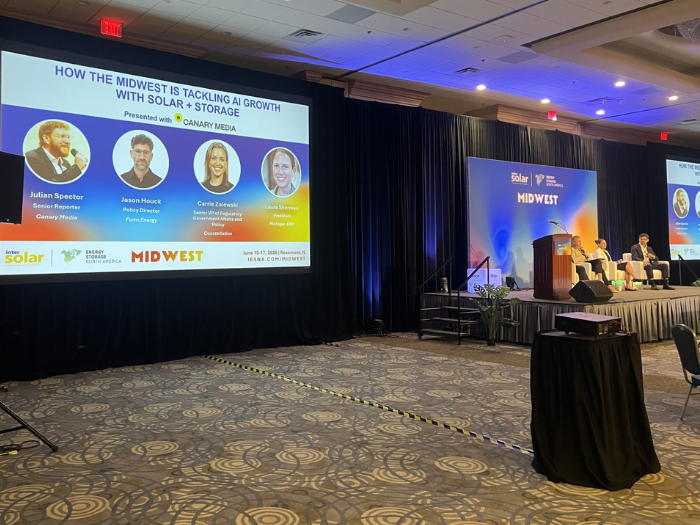
Presented by Canary Media, the Day 2 keynote breakfast at the Intersolar & Energy Storage North America (IESNA) Midwest conference and trade show took on a question that has become central to the clean energy conversation: can solar, storage, and other renewables actually meet the 24/7 energy demands of the AI data center boom?
Moderator Julian Spector, Senior Reporter at Canary Media, opened with a show of hands that revealed the room’s skepticism. Few believed clean energy tools are currently capable of meeting that bar unassisted.
The keynote, featuring Jason Houck, Policy Director at Form Energy, Carrie Zalewski, SVP of Regulatory Government Affairs and Policy at Constellation, and Laura Sherman, President of Michigan’s Energy Innovation Business Council (EIBC), spent the next hour making the case for why that may be changing, and why the Midwest is where the proof points are emerging.
The Case for Clean Energy Meeting AI Demand
Houck offered the most concrete example: a 300-megawatt iron-air battery project that Form Energy is deploying with Xcel Energy in Minnesota to support a proposed Google data center.
At 100 hours of duration, it’s part of a 1.9-gigawatt clean energy and storage portfolio and represents the largest announced battery project by energy capacity in the world. His broader argument was that the Midwest is naturally suited for this combination — abundant, cheap renewables paired with multi-day weather events that short-duration storage alone can’t address.
Form’s first utility customer, Great River Energy in Minnesota, signed on before the chemistry was even public, a reflection of how seriously long-range planners in the region take the multi-day reliability problem.
Michigan: Policy Driving Procurement
Sherman walked through Michigan’s Clean Energy and Jobs Act, which mandates 4,500 megawatts of storage procurement across the state’s utilities and requires the commission to study long-duration storage — targets that grew directly out of modeling EIBC had done on what the grid would need to balance a renewables-heavy future.
The most active proceeding right now involves Google’s proposed data center with DTE Energy, structured around a Clean Capacity Accelerator Agreement covering up to 1,600 megawatts of renewables and 480 megawatts of storage. Michigan’s EIBC is pushing for third-party ownership of those resources and rigorous accounting of the promised customer benefits.
Sherman was direct: Michigan has some of the highest electricity rates in the Midwest, and every projected benefit to ratepayers needs to be tracked and verified, not assumed.
She also flagged the Oracle data center battery project in Saline Township, where grid-connected storage is being funded by the hyperscaler, as an interesting model but one that was approved without a full contested case process, a standard the Google proceeding is now setting.
Illinois, Nuclear & the Flexibility Play
Zalewski drew on her background as former chair of the Illinois Commerce Commission and her current role at Constellation, the country’s largest clean energy independent power producer (IPP).
Her argument for nuclear in the AI context was practical: it’s always-on, carbon-free, and already connected. The Three Mile Island restart in Pennsylvania, expected around 2028, is the clearest example of using existing infrastructure to get to megawatts fast, which is what hyperscalers prioritize above almost everything else.
Her more forward-looking point was about flexibility. The grid is built for roughly 60 to 80 hours of peak stress per year. Outside those windows, supply is adequate. The real opportunity for distributed solar, storage, and virtual power plants (VPPs) is covering those peak hours without permanently overbuilding for them.
She pointed to Base Power, launching in Illinois with a model that places small batteries in homes, pays homeowners to host them, and aggregates that capacity to bid into the grid during high-price periods, as one early example of where this is heading.
The Distributed Connection
Spector asked how large-scale AI energy deals connect to the EPCs, developers, and distributed solar installers in the room. The answer across all three panelists was VPPs.
Michigan’s Integrated Resource Plan (IRP) rules now require utilities to model VPPs in their planning processes, and EIBC is pushing in the Google case for some of Google’s capacity needs to be met through customer-sited solar, storage, and smart thermostats.
The logic: hyperscalers have the capital to fund distributed infrastructure that benefits the broader grid, not just their own facilities. Zalewski added that community solar bundled into hyperscaler deals, directed to low-income customers, is another model worth watching.
Risks & the Public Opinion Problem
Zalewski raised the sharpest concern of the session: public approval of data centers has fallen to around 25 percent in recent polling, and storage projects are increasingly being conflated with data centers in the public mind. Both look like rows of metal containers. The result is opposition to storage driven by data center anxiety, which is a real and growing problem for developers.
Sherman added that load forecast accuracy compounds this: when utilities announce gigawatt-scale data center demand and the numbers get revised down repeatedly, it erodes trust and can paralyze regulators. Houck’s counterpoint was that the value of long-duration storage isn’t contingent on the data center buildout.
The reliability problem it solves is real regardless of what’s driving demand growth, and the technology matters whether or not AI demand continues at its current pace.
Vision for Ten Years Out
Spector closed by asking each panelist for a one-sentence vision of the Midwest’s clean energy buildout a decade from now.
The answers converged: abundant renewables paired with a full portfolio of storage durations, domestic manufacturing supporting the build, and customer rates low enough that most people simply don’t think about their electric bill.
In Zalewski’s framing, the best outcome is one where the transition happens without negatively impacting people’s livelihoods, and ideally improves them.