

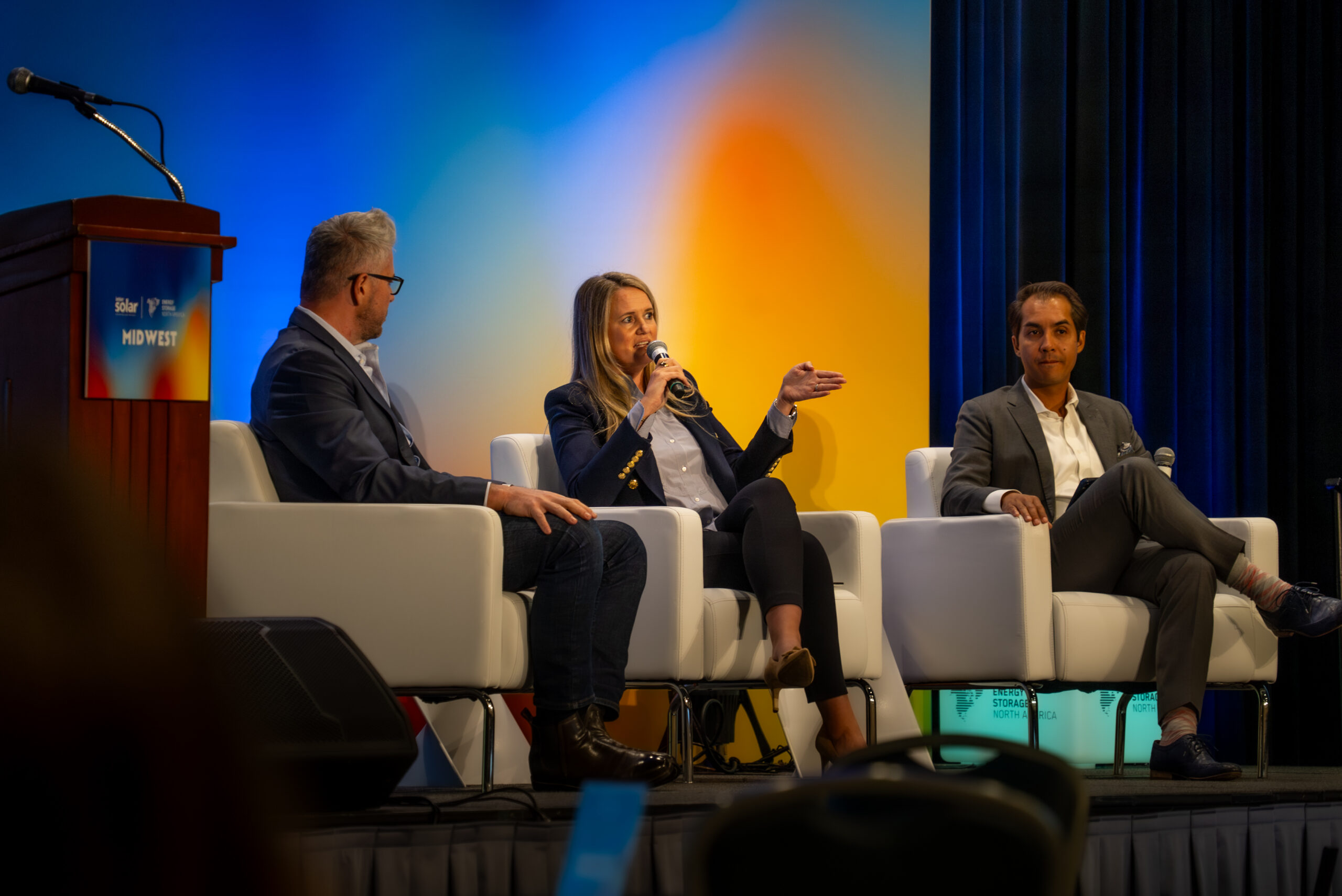
The lunch keynote on Day 1 of the Intersolar & Energy Storage North America (IESNA) Midwest conference and trade show brought together perspectives from two sides of the project delivery equation: the owner-operator deploying capital over a 35-year horizon, and the EPC tasked with putting steel in the ground at unprecedented scale.
Moderated by Yann Brandt, CEO of SolarWakeUp, the conversation with Helena Kimball, Chief Revenue Officer at SOLV Energy and Nick Maynard, VP – Engineering at Arevon Energy covered project scale, construction speed, automation, labor, supply chain, and what it takes to get a project from backlog to energization in today’s market.
The backdrop Brandt set was useful context: between 1990 and 2020, MISO energy demand was essentially flat, growing from 108 to 119 gigawatts over three decades. MISO now projects demand could grow nearly 50 gigawatts by 2035 — close to a 50 percent increase in 15 years.
Against that backdrop, the conversation had an urgency to it that wouldn’t have existed even five years ago.
Scale is the New Normal
The single biggest theme of the session was scale, and how fundamentally it has changed what execution looks like.
Kimball noted that SOLV’s active project portfolio now includes several projects individually north of 600 megawatts, bringing the company’s average project size to just over 300 megawatts. She framed this shift with some perspective: the first utility-scale project she worked on at Recurrent Energy was five megawatts.
Maynard echoed the point from the developer side. Arevon is heavily invested in the Midwest, with projects in Illinois, Indiana, Arkansas, and Missouri. The pipeline filtering process has become more rigorous as a result of domestic content requirements, tariffs, interconnection challenges, and other regulatory variables.
What might start as 50 gigawatts of development pipeline, he said, can get filtered down to 5 gigawatts of truly viable projects once you run everything through a binary test of what actually works financially and operationally. The imperative now is identifying the right projects earlier and committing to them with the right partners.
Rethinking the Developer-EPC Relationship
One of the more substantive shifts both panelists described was a move away from competitive Request for Proposal (RFP) processes toward earlier, deeper partnerships between developers and EPCs.
Maynard used a marathon analogy: rather than actually running faster, Arevon has effectively started the race two hours earlier by bringing SOLV into the project lifecycle before contracts are signed and before the formal solicitation process begins.
The cost of that early engagement, he noted, is less than one percent of total all-in capex, and the return is dialed-in pricing, fewer surprises during execution, and significantly less Internal Rate of Return (IRR) erosion by the time a project reaches financial close.
Kimball described the same dynamic from the EPC side. Customers are increasingly moving toward bilateral negotiations, skipping the RFP process entirely with trusted partners, and engaging EPCs at the design stage to work through project constraints and do value engineering from the start.
The result is faster delivery and better outcomes for both sides. She also noted that SOLV now has pipeline visibility into Arevon projects a year to a year and a half earlier than would have been typical under the old model.
Speed, Automation & the 15-Minute Rule
Maynard was direct on speed: schedule is king, and waiting until contracts are signed to tackle permitting, design, and procurement is one of the industry’s most expensive habits.
The single biggest bottleneck, he said, is permitting — though the Midwest is considerably easier to navigate than markets like California, where a building permit alone can take two or more years.
Kimball took the conversation into operational territory. SOLV now treats large job sites as manufacturing environments, tracking people, vehicles, and equipment in 15-minute increments — shaving 15 minutes out of each day can add up to months of schedule improvement over the life of a build.
On automation, the company is piloting robotics with TerraFab, Grit Robotics, and Built Robotics across pile installation, module placement, and modular assembly. Autonomous rover-based pile installation is already live across 200 megawatts of projects. Headcount hasn’t changed; the same workers are on site, just redeployed more effectively. The goal? To build three times faster than today’s pace.
Automation, Labor & the Midwest Context
Brandt pushed both panelists on how they balance the appeal of new technologies with the risk of deploying unproven solutions on large, schedule-sensitive projects.
Maynard’s answer centered on bankability: any new technology or product that an owner-operator considers has to clear a filter that includes independent engineering studies, test facility validation, and documentation that can be taken to lenders. Without that, the conversation doesn’t happen.
Kimball added nuance from the field. Automation isn’t equally applicable everywhere. SOLV’s teams in Texas, for example, are highly experienced crews who have little interest in automation and will outperform it when conditions favor them. The approach is selective: automation gets deployed where it pencils, particularly in high-labor-cost markets.
The Midwest now qualifies, given that most projects in the region require union labor. In those markets, the economics of automation are increasingly compelling, and SOLV is now factoring it into project estimates as a line item rather than a pilot experiment.
For startups in the room, Maynard offered a clear-eyed summary of how to get in front of developers like Arevon: pass the filter. Domestic content compliance or a credible path to it is essentially table stakes now.
Beyond that, a new entrant needs bankability documentation, independent engineering validation, and the ability to demonstrate that the product works at scale. A 30-megawatt pilot within a 600-megawatt project is one way to build that track record, and Maynard suggested that the risk is manageable for developers willing to try.
What It Means for the Industry
Overall, Tuesday’s lunch keynote pointed to the fact that execution has become the competitive differentiator in utility-scale solar.
Pipeline is easy to accumulate; getting projects built on time, within budget, and to a standard that satisfies lenders is hard. The developers and EPCs that are winning right now are the ones that have reorganized around that reality: earlier partnerships, tighter supply chain control, data-driven construction management, and a willingness to invest in new technologies when the economics justify it.
For the broader industry, the discussion reinforced something the morning keynote had also surfaced: the scale of what is being asked of this sector right now is genuinely unprecedented.
MISO’s demand projections, the Safe Harbor project timelines converging on 2028 and 2030, and the pace at which data center and industrial load is arriving all point in the same direction. The industry has the tools and the talent. The question is whether it can deploy them fast enough.