


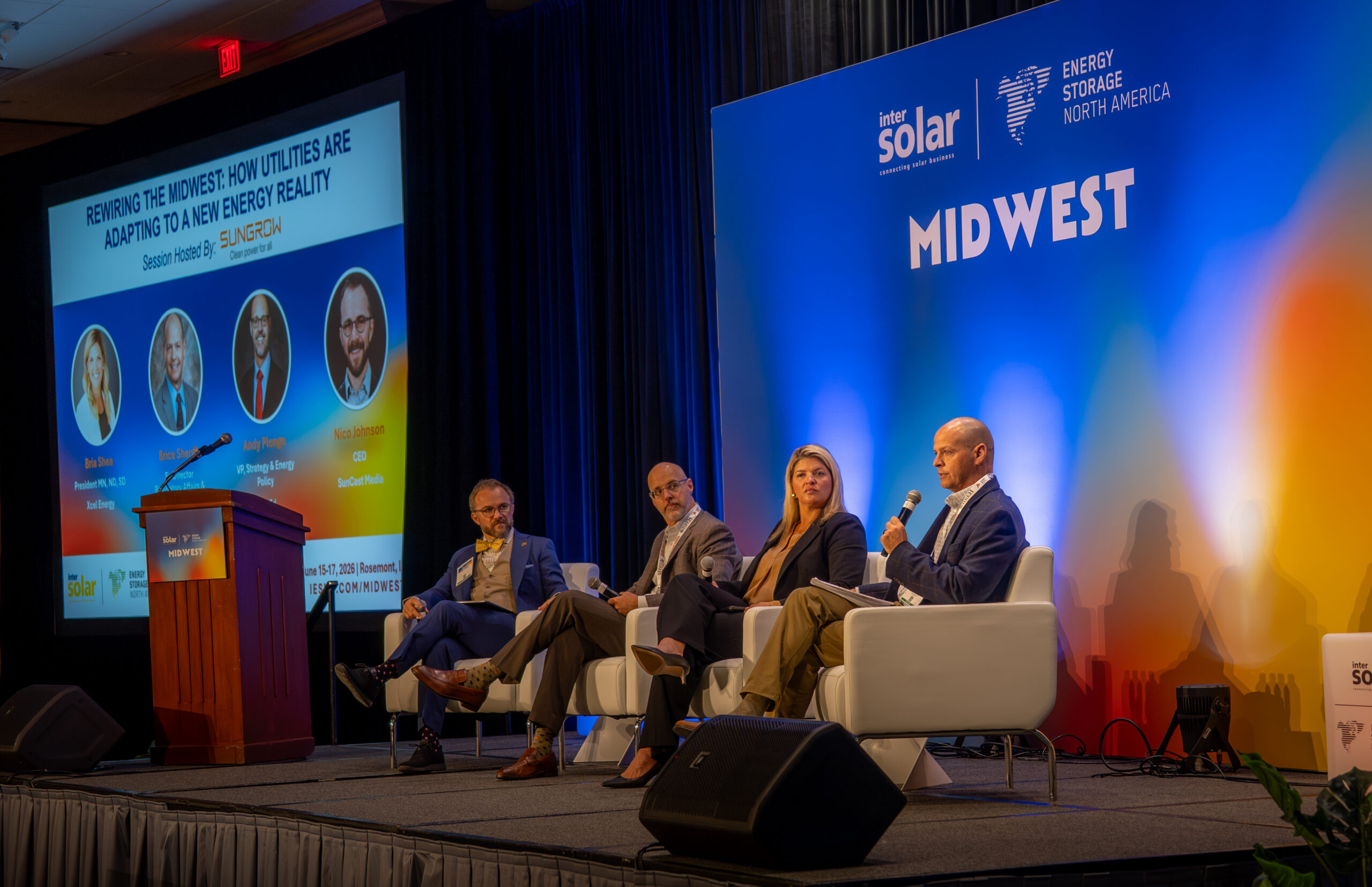
On the morning of Tuesday, June 16 in Rosemont, Illinois, a room full of solar and storage professionals got a rare thing: utility executives being candid about how much has changed and how much they still don’t know.
The opening keynote breakfast at the Intersolar & Energy Storage North America (IESNA) Midwest conference and trade show brought together three of the region’s largest electric utilities for a conversation that touched on data centers, grid infrastructure, Illinois energy policy, and what it actually means to keep the lights on when the rules of the system are being rewritten in real time.
Moderated by Nico Johnson, host of the SunCast podcast, the discussion featured Bria Shea, President of Xcel Energy – Minnesota, North Dakota, and South Dakota; Andy Plenge, VP, Strategy & Energy Policy at ComEd; and Brice Sheriff, Senior Director, Regulatory Affairs & Energy Supply at Ameren Illinois.
Load Growth: The Variable No One Can Pin Down
Ask any of the three panelists what has changed most in utility planning over the past five years, and the answer comes back the same: load growth, not just in scale but in its unpredictability.
Hyperscalers, EV fleet operators, and manufacturers are making siting decisions on timelines that have little to do with how long it takes to permit and build grid infrastructure. Shea put it plainly: technology companies move at the speed of technology. Utilities have historically moved at the speed of infrastructure. Those two speeds are now in direct conflict.
Xcel’s response has been to throw out the sequential planning playbook. Generation first, then transmission, then distribution: that approach is gone. Now all three tracks run simultaneously, with reliability redefined not just as having enough generation, but having the right generation in the right place at the right time.
At ComEd, the numbers are stark. The utility’s 2011 peak load of 24 gigawatts was still its record, yet it’s now fielding at least that much in pending customer inquiries before a single new large load has officially come online. Chicago has been a top-tier data center market since 1999, but the volume and pace of what’s arriving now is different in kind, not just degree.
Plenge also flagged the timeline mismatch that makes distributed resources so critical right now: a data center comes online in roughly 24 months, while a new gas plant takes five to seven years. That gap isn’t closing anytime soon.
A Grid Built for Another Era
Sheriff offered a useful frame for understanding Ameren Illinois’s infrastructure challenge. The system his utility operates was built around small, dispersed coal plants, each designed to move power 15 to 20 miles.
Most of that coal is now retired, but the grid it served is still there, now being asked to handle two-way power flows and distributed resources it was never engineered for. That physical reality shapes everything from interconnection timelines to where investment needs to go first.
Illinois’ response has been to mandate far more intensive planning processes. Ameren’s most recent integrated grid plan required 105 stakeholder meetings, up from about 20 for the previous filing in 2023. That’s not hours — that’s meetings.
Sheriff acknowledged the process can be exhausting, but framed it as essential: the renewable development community, community advocates, and regulators are all in those rooms, and getting alignment before a plan is filed beats relitigating it afterward.
Sheriff also flagged the newly effective Clean and Reliable Grid Affordability (CRGA) Act, which introduces integrated resource planning requirements that Illinois utilities haven’t navigated since deregulation.
The Integrated Resource Plan (IRP) is unfamiliar territory, but he sees it as a valuable communications tool, giving policymakers and general assembly members a concrete document to reference when making decisions about long-term infrastructure needs that can take years to fully understand.
Affordability: It’s More Complicated Than the Headlines Suggest
The affordability question came loaded. Energy bills have been front-page news, and data centers have become a convenient villain in that narrative. The panelists largely pushed back, though not without acknowledging the real pressures customers are facing.
Shea was direct: at Xcel, data centers aren’t driving up costs. They’re spreading them. The utility’s rates run about 30% below the national average, and large commercial customers help distribute fixed infrastructure costs across a broader base, making bills lower for everyone else. Done right, she argued, the data center boom doesn’t create an affordability problem. It can help solve one.
Plenge’s picture was more complicated, though he was careful to separate causes. ComEd is a wires-only utility that passes supply costs directly to customers, and those costs have more than doubled since 2023, rising from roughly $30 to around $70 per megawatt-hour, driven largely by natural gas price volatility following the war in Ukraine. That increase is what’s showing up on bills, and it has little to do with data centers.
ComEd’s strategy for managing affordability runs on several tracks at once: cost-benefit requirements on all proposed grid investments, Illinois’ regulatory benchmark keeping household energy spending below 3% of income, aggressive deployment of rooftop and community solar because those projects come online in months rather than years, and customer assistance programs that directed over $100 million to residents last year alongside a new $2.5 million small business initiative.
What It Means for the Industry
The through line of the conversation was consistent across all three perspectives: utilities need to move faster, and distributed solar and storage are the most deployable near-term tools they have. That’s an opening for the industry, and the panelists were explicit about it.
The planning frameworks Illinois has put in place through the Climate and Equitable Jobs Act (CEJA) and CRGA also create a more legible regulatory environment than the state has seen in years.
For developers and installers willing to engage seriously in stakeholder processes, those frameworks offer real opportunities to shape outcomes rather than just respond to them.
The affordability story, meanwhile, is worth getting right. The data center narrative dominating national headlines doesn’t apply uniformly across markets. In some utility territories it’s accurate; in others it obscures what’s actually driving costs.
Companies that understand those local dynamics and can communicate clearly about the difference between supply cost volatility and infrastructure investment will be better positioned in conversations with customers, regulators, and the press.