
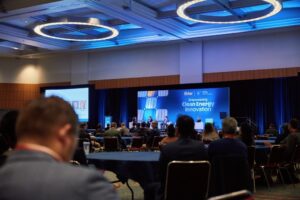
 With federal clean energy policy in flux, the opening keynote at the Intersolar & Energy Storage North America (IESNA) Flagship event made one thing clear: the states aren’t waiting.
Moderated by Sammy Roth, independent climate writer and author of the Climate Colored Goggles Substack, the panel brought together four regional energy leaders to examine how states are filling the void left by federal rollbacks – and what it will take to sustain momentum.
The session featured Doreen Harris, president and CEO of NYSERDA; Michael Judge, undersecretary of energy at the Massachusetts Executive Office of Energy and Environmental Affairs; Arnab Pal, executive director of Deploy Action; and Lynnae Willette, director of regulatory and legislative affairs at EDF Power Solutions.
A 180-Degree Turn
Each panelist described a dramatic shift in their day-to-day work. For Willette, who works on both Texas state and federal policy, the transition was stark. “My job took a complete 180,” she said. “We went from implementing the IRA to doing what we could to protect our projects in play.”
Judge echoed the sentiment from Massachusetts, where grant terminations and stalled offshore wind contracts have forced a major recalibration. “Every day, it seems there’s something new: a grant that’s been canceled, a project that’s been halted,” he said.
Harris noted that the instability has impacted any generation or infrastructure project that needs durable policy to progress. “Uncertainty equals risk, and risk equals cost,” she explained. “This is not just about renewable energy.” New York finalized its state energy plan late last year against a backdrop of federal tax credit repeals and mounting market uncertainty. Every project in the state’s interconnection queue is wind, solar, or storage. By threatening these resources, uncertainty also destabilizes energy affordability and grid reliability.
Affordability as the New Battleground
The conversation quickly converged on energy affordability, not just as a political challenge, but as a genuine opportunity for clean energy advocates to reframe their message.
“The conversation changed from reliability to affordability in 2025,” Willette said of Texas, where Storm Uri had sent the state on a costly quest for gold-plate reliability. At the time, ERCOT had deployed only 3,000 megawatts (MW) of storage. Five years later, Texas has a whopping 16,000 MW of storage – with another 14,000 MW expected by year-end – driving residential electricity prices two cents below the national average and wholesale prices to among the lowest in the nation.
Harris urged the industry to broaden how it defines energy costs. In New York, many depend on delivered fuels like propane and oil, and the state’s infrastructure is aging. “Business as usual – meaning no clean energy transition – would still cost $150 billion a year just to maintain existing systems,” she said. For many households, the transition means energy burden reductions of one to three hundred dollars a month. “It really starts with education,” she said.
The panel’s most vivid proof point came from the New England cold snap just weeks ago. Oil generators that normally run one percent of the year ran for days, driving spot market prices as high as $870 per megawatt-hour, while an offshore wind facility delivered 600 MW at a price ten times lower. “These resources are critical at all times of the year,” Judge said. “They are providing direct savings and reliability benefits for consumers.”
To Pal, the bigger problem is marketing. In states where solar and storage have thrived, consumers facing high bills can draw the wrong conclusion. “The truth is the very opposite,” he said — in California, generation costs have remained largely flat, while transmission and distribution are the real cost culprits. He advocated for a coordinated, industry-wide campaign with a simple message: “We had an affordability solution — and it was ripped out.”
Navigating Federal Roadblocks
The panel addressed the administration’s efforts to block or slow renewable energy permitting, not just on federal lands, but through Army Corps and other agencies affecting private land development.
Willette urged early and consistent engagement, from the grassroots up to the “grass tops.” When federal permitting memos started landing, she briefed the Texas governor’s office and Public Utilities Commission on how restrictions could affect the interconnection queue and the load growth Texas is counting on. She pointed to a Virginia offshore wind project that advanced permits through a public-private agreement between a congresswoman, Dominion, and a naval base. “The art of the deal is sometimes coming up with a public-private solution that may be able to advance your project,” she said, while acknowledging litigation may be a necessary backstop.
Pal counseled against being too consumed by the moment. “Instead of thinking about how we deal with what’s today, it’s how we plan for what’s going to happen in January 2027 and January 2029,” he said. “You have to have your asks ready.”
A Vision for National Policy
When asked what ideal federal clean energy policy would look like, Harris called for a tech-neutral approach that evaluates all resources on a level playing field. Judge appealed for stability. “We’ve been ping-ponged back and forth,” he said. “When you have that pendulum swinging, it’s impossible to do the long-horizon planning necessary for these projects.”
Pal called for a long-term bipartisan deal on tax credits and a $25 billion marketing budget attached to the next major policy package. “I still don’t believe people really knew what the IRA was doing for this country,” he said — and by extension, many don’t know what they’ve lost.
Willette kept it simple: a permit certainty bill and more transmission. “Who doesn’t love more transmission?” In a year defined by attrition, the prescription was straightforward – stability, certainty, and the infrastructure to move power where it’s needed.