



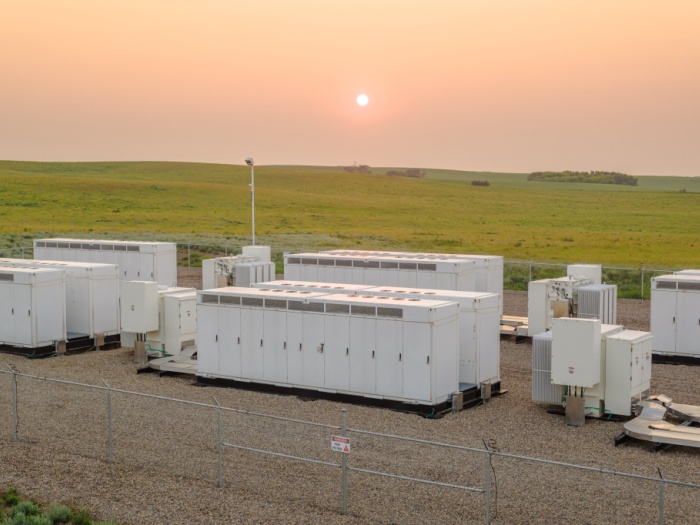
U.S. utility-scale battery storage capacity reached nearly 52 gigawatts (GW) by mid-2026, growing at an average annual rate of 70% over the past three years, according to the U.S. Energy Information Administration.
Operators added 8.3 GW in the first six months of 2026 alone, building on the 43.6 GW of operational capacity in place at the close of 2025.
Solar photovoltaic co-location is the dominant model driving large-scale deployments, with the country’s biggest battery storage projects all tied to solar generation.
According to Energies Media, California’s Bellefield Solar and Energy Storage Farm, which began operations in December 2025, currently leads with 500 megawatts (MW) of solar capacity paired with 500 MW of storage.
Florida’s Manatee Solar Energy Center ranks second with 409 MW of battery storage, and Nevada’s Gemini Solar Hybrid rounds out the top tier with 380 MW of storage.
The economics driving this buildout are straightforward. Solar-plus-storage operators can charge batteries when wholesale electricity prices are low during peak solar hours, then discharge stored power during evening peak demand periods when prices are higher.
Operators have reported plans to bring an additional 54 GW of battery storage capacity online through 2028, including 14 GW in the second half of 2026, 26 GW in 2027, and 14 GW in 2028.
If those plans hold, total U.S. utility-scale battery storage capacity would more than double from its current level by the end of 2028.
Read more here.