

A conversation with the President and CEO of NABCEP, a partner of Intersolar & Energy Storage North America, on plug-in solar risks, global expansion, and why certification isn’t just for residential installers.
Organization: NABCEP (North American Board of Certified Energy Practitioners)
Focus: Solar and storage certification
Featuring: Shawn O’Brien – President & CEO
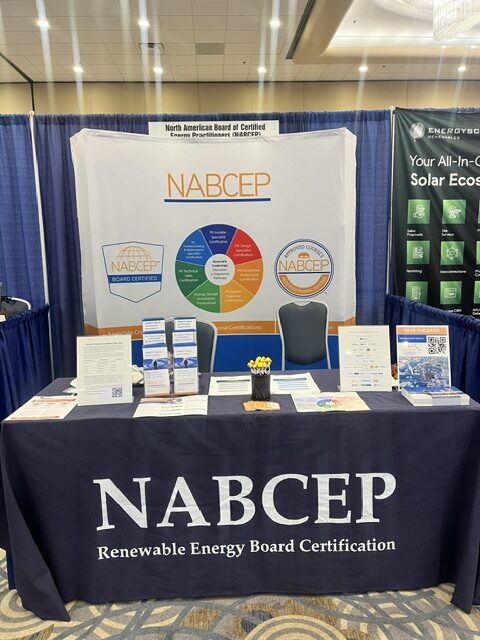
Show Presence: Increased engagement with EPCs (engineering, procurement, and construction firms), continued regional focus on Illinois programs including the International Brotherhood of Electrical Workers (IBEW) partnerships and Solar for All
During Intersolar & Energy Storage North America (IESNA) Midwest, Digital Editor Krista Simicich sat down with Shawn O’Brien, President and CEO of NABCEP, to talk certification, industry growth, and a consumer safety trend he’s watching closely: plug-in, or “balcony” solar.
A DIY Trend with Hidden Risks
When asked what challenge he sees facing the industry right now, O’Brien didn’t hesitate to name one: the rise of plug-in solar products marketed directly to homeowners as a simple do-it-yourself project.
“There’s a real education gap around what these systems can do,” O’Brien said. His concern isn’t with the concept of plug-in solar itself, but with the fact that consumer marketing hasn’t kept pace with the electrical safety knowledge homeowners need.
Plug-in units can feed power back into the grid, and without the right safeguards in place, that creates real risk, not just for the homeowner, but for utility lineworkers who could be exposed to unexpected current if a system keeps feeding power into the grid during an outage.
More utilities are now requiring interconnection agreements for these plug-in systems, a detail most homeowners installing a balcony solar kit from an online retailer likely aren’t aware of.
O’Brien isn’t arguing that DIY solar shouldn’t exist. His point is that it deserves an expert checkpoint. “Yes, it’s a do-it-yourself, but maybe bring in an expert to commission it,” he said. “Make sure you did it right.”
What NABCEP Is (And Isn’t)
O’Brien is quick to correct a common misconception: NABCEP is not an association. “Pretty much anyone can join [an association] as long as you pay the membership fee,” he explained. NABCEP is a certification board. Becoming board certified requires education, verified experience, passing an exam, and adhering to an enforceable code of ethics.
That last part matters. “There’s a lot of industry organizations that say they have a code of ethics, but they don’t enforce it,” O’Brien said. NABCEP does. The organization maintains an ethics committee that investigates complaints and helps mediate resolutions for consumers. With no state licensure requirement for solar installers in most of the U.S., O’Brien described NABCEP’s role plainly: “We kind of become like the police of the industry.”
For homeowners, that means peace of mind that a project follows best practices. NABCEP-certified professionals are required to complete continuing education every three years to stay current.
For businesses and utility-scale developers, it means protecting a larger financial asset. O’Brien pointed to data suggesting certified installers reduce operations and maintenance costs over time, simply because the work gets done correctly the first time.
Not Just Residential
One message O’Brien wanted IESNA Midwest attendees to leave the show with: NABCEP’s roughly 30,000 certified professionals aren’t limited to residential solar. “It’s residential, commercial, utility,” he said, a correction he finds himself making often. People are often surprised to learn the scope of NABCEP’s reach, expecting the organization’s work to be focused solely on residential solar.
That range now includes a brand-new credential, OMAT (Operations & Maintenance Associate), an entry-level certification built for operations and maintenance technicians. Many large O&M companies run their own in-house training, but OMAT gives smaller teams and individual technicians a way to demonstrate core knowledge of safety, terminology, and existing infrastructure, the fundamentals needed to work safely in the field.
Going Global
NABCEP’s name no longer tells the full story of where it operates. Originally founded 24 years ago as the North American Board of Certified Energy Practitioners, the organization has expanded well beyond that footprint.
It now has offices in the Middle East and St. Kitts serving the Caribbean (NABCEP Caribbean), with plans to open an additional office in Mexico, most likely in Guadalajara, later this year. NABCEP is also active in Canada, working with Hydro-Québec.
Why the Midwest Show Matters
O’Brien noted a shift in who he was talking to on the floor this year: more representatives from EPCs than in past years, a trend he’s glad to see. Growing that relationship, and helping EPCs understand the value of working with NABCEP-certified professionals, is a growing priority for the organization.
Illinois in particular remains an active market for NABCEP. The state has seen significant training activity tied to its PV associate credential, along with partnerships with organizations like the IBEW and participation in programs such as Solar for All. “This is important to us, this region,” O’Brien said.
Interested in learning more about NABCEP certification? Visit nabcep.org to explore their credentials and find certified professionals near you.